A new home for Developmental Spaces
We've brought four sites together into one, put our courses online in full, opened the fund archive, added a wiki, and given the whole thing a new look. Here's the story.
A new home for Developmental Spaces
Hello, Rufus here. If you're interested in conscious communities – living in one, starting one, or funding one – there is now one place to start: this site. Over the past weeks we've brought together what used to be spread across four separate sites, published a lot of material that was sitting in drawers, and given the whole thing a new look. This post tells the story and gives a tour.
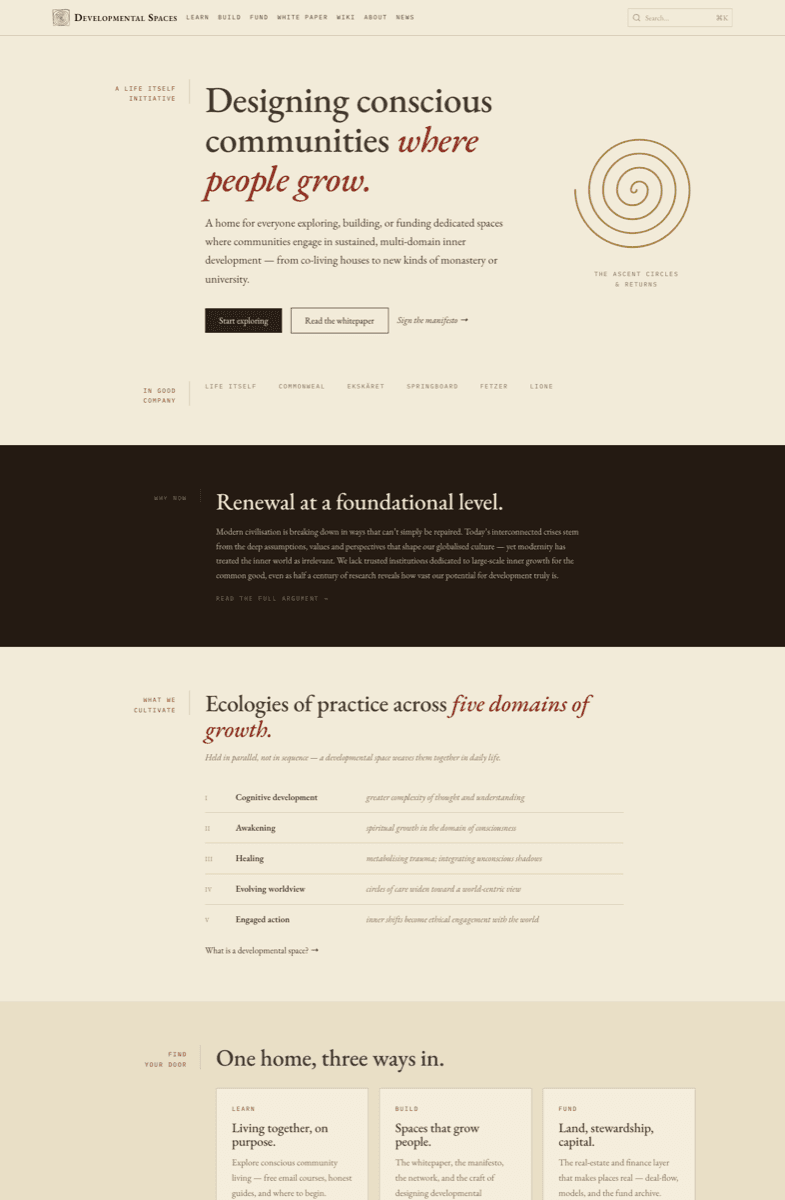 The new home page: one home, three ways in.
The short version
- Our three email courses on conscious coliving are now readable online in full – around 27 lessons, free.
- We've published the fund archive: the complete materials from our 2019–2021 work on a real-estate fund for conscious community.
- There's a new wiki with our working notes on inner development and developmental science.
- developmentalspaces.org is now the single home for this work: consciouscoliving.org and tealestate.net have moved in, and their old addresses redirect here.
- The site is organised into three streams: Learn if you're exploring conscious community living, Build if you're creating a space or working on the field, and Fund if you're interested in the capital side.
- And the site has a new design, which you're looking at.
Why we did this
Over the years a few different entry points had grown up around this work: developmentalspaces.org for the concept and the whitepaper, consciouscoliving.org for people curious about coliving, tealestate.net for the real-estate and capital side. Each made sense on its own. But they were really strands of one question:
How do we create conscious communities that support human flourishing and collective renaissance?
Having them scattered meant nobody could see the whole. Someone who found the coliving courses never discovered the whitepaper; someone reading about the fund never found the courses. And maintaining several barely-active sites was worse than maintaining one active one. When we asked the community about consolidating back in February, the response was clearly in favour.
There's also a bigger logic behind it. For more developmental spaces to exist in the world – communities, retreat centres, even new kinds of monastery or university – several things have to work together: people need to discover this way of living, pioneers need knowledge and a field to build within, and projects need capital. The site now mirrors exactly that:
Learn – living together, on purpose
The Learn stream is for anyone exploring conscious community living. The centrepiece is our three free courses, which used to exist only as email sequences and are now fully readable online:
- Conscious Coliving 101 – start here if you're new
- Conscious Coliving in Action – practical steps towards joining or starting a space
- Transforming Conflict in Community – for when living together gets real
Plus a curated reading list and pointers to real places. A fourth course on practice psychology is in preparation.
Build – spaces that grow people
The Build stream holds the concept and the craft: the whitepaper, the manifesto, the network, and design knowledge for anyone creating these spaces. New here: a vision and strategy page with talks and decks, and the wiki – some 65 working notes on developmental science, practices and maps that previously lived in a private course knowledge base. It's a garden, not a book: notes range from polished to raw.
Fund – land, stewardship, capital
The Fund stream continues Teal Estate. The most substantial new material on the whole site is here: between 2019 and 2021, together with Ian Sneath, Mark Bogues and Gavin O'Driscoll, I worked seriously on creating a real-estate fund for conscious community. It didn't launch in the end, but the thinking was extensive and much of it holds up. We've now published the archive: the full prospectus, the strategic analysis, our study of who invests in conscious community, the governance design, and a project application questionnaire that could still be useful if your project is looking for funding.
The new look
The old site did one thing well: it presented the whitepaper, plainly, in black and white. Almost monastic – probably too much so. The coliving material, meanwhile, had lived in a warm and colourful world of its own. The new design tries to hold both: warm parchment tones and readable type at the front door, with darker, quieter passages for the manifesto and the deeper argument. The spiral – which has been on our whitepaper cover from the start, an image of growth that circles and returns rather than climbing in a straight line – is now the site's mark.
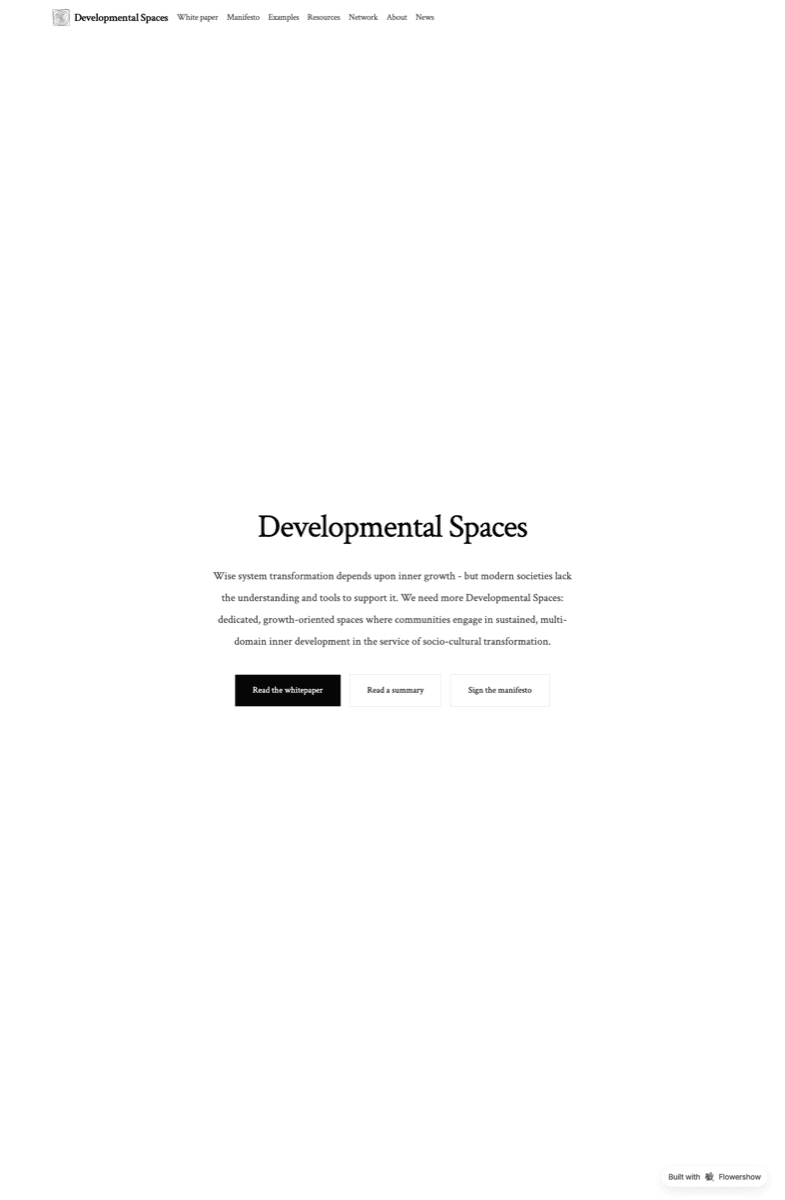 Before: the whitepaper landing page.
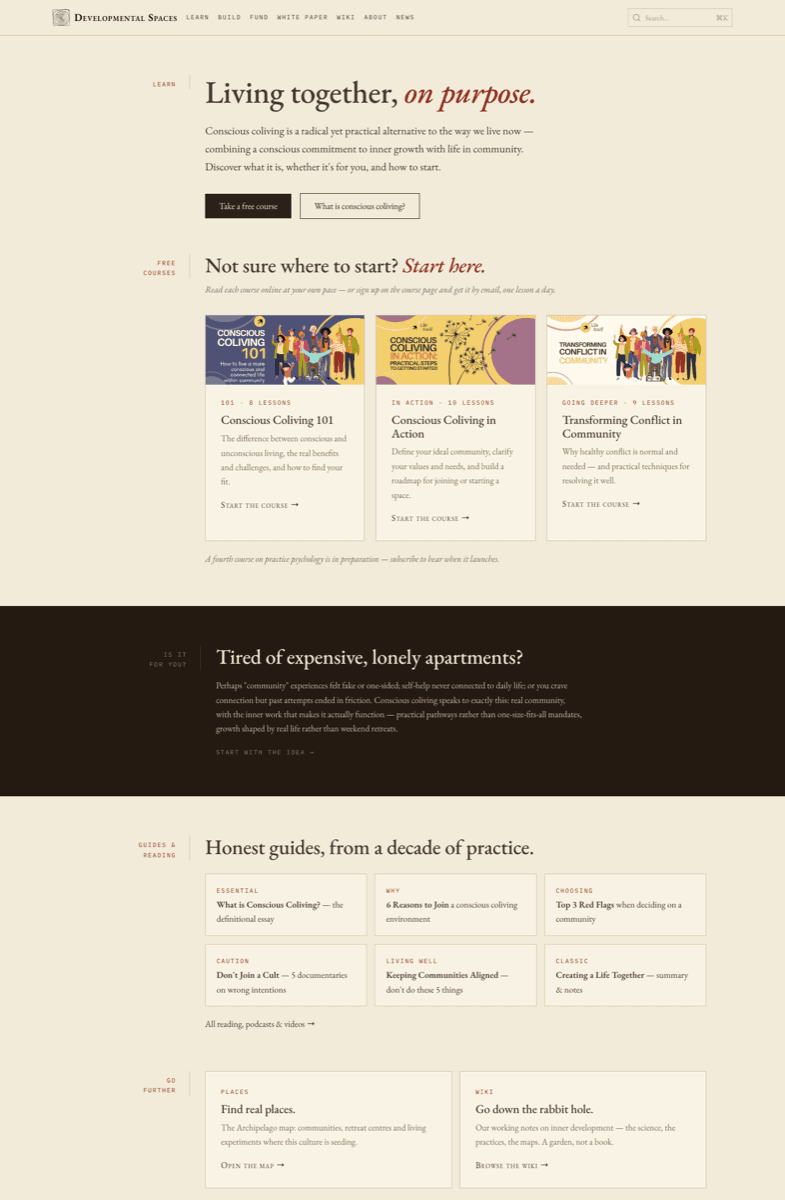 After: the Learn stream, with the courses now readable online.
What's next
This is a beginning more than an ending. Coming up, roughly in order:
- More from the archives: talks and recordings from the 2023 launch onwards, and further fund-era material.
- The practice psychology course.
- Continuing to publish project fundraising updates in the Teal Estate section of our newsletter.
If you want to follow along, the newsletter is the best way. And if any of this connects with something you're exploring, building or funding, do write: developmentalspaces [at] lifeitself [dot] org.
Appendix: for the curious
Some notes on how we went about this, for those who like the workings.
Information architecture first, design second. We spent the effort up front on getting clear what the site is for and who it serves, wrote that down (a brand narrative, job stories for each stream), and only then did the visual work. The three streams follow the underlying theory of change rather than our org chart, and the test we used for every page: any new piece of content should have exactly one obvious home.
Naming. We went back and forth on whether the home should be "Conscious Coliving" (warmer, more accessible) or "Developmental Spaces" (stronger, more precise). We landed on a layered answer: Developmental Spaces is the name and the spine; conscious communities is the language of the front door. Hence the tagline: Designing conscious communities where people grow.
Content is web-first now. The courses were locked inside an email automation tool. We pulled them out; the web pages are now the canonical version and email delivery is built on top – a small piece of infrastructure we wrote ourselves, which also handles the signup forms on this site. One consequence you might appreciate: signup forms are now a simple email box rather than an embedded widget.
Nothing was thrown away. The old sites' content is archived in full, old URLs redirect, and the fund materials that didn't make sense to publish as pages remain preserved privately.