Conscious Coliving in Action: Practical Steps to Getting Started — Day 1
Day 1: Conscious Coliving in Action
Part of the free course Conscious Coliving in Action: Practical Steps to Getting Started. Prefer it paced? Get it by email — one lesson a day.
Day 1: The Full Spectrum of Conscious Coliving
Dear conscious human,
Ask the average person what conscious coliving is and you’ll probably get answers along the lines of “a bunch of communist hippies living in a cult and sharing toothbrushes”, to which we would say exactly … oh no, hold on … 👀
Conscious coliving is a relatively novel term and we’re doing our bit to make it more mainstream and bust myths like the above. There is a way to go, but we’ll make it!
It’s a common misconception that conscious coliving is about sharing everything and that you have to be a hippy (we cover all the myths in Conscious Coliving 101), but this is far from the truth. Let’s share some concrete examples of what conscious coliving might actually look like:
-
A group of monks living in a remote mountain monastery in Thailand
-
4 colleagues working different 9-5 jobs and sharing a flat in London
-
2 families on a plot of land in Sweden with tiny homes on it
-
A small village in Northern Italy
-
An ecovillage such as Findhorn in Scotland
A spectrum of conscious coliving
It’s not like you are consciously coliving or you are not. Most people who live together will most likely be experiencing some level of conscious coliving. It’s a spectrum, you see!
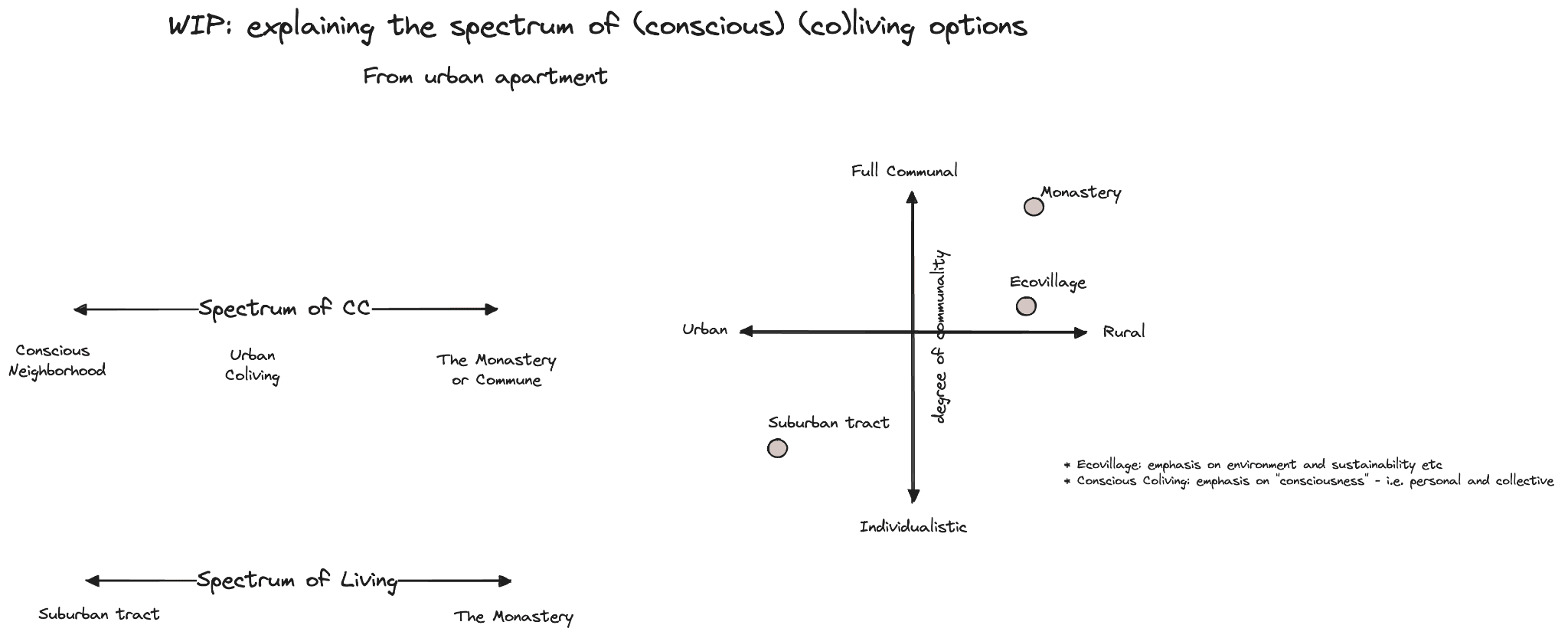
Conscious coliving is not a particular type of environment; is it that a level of consciousness is present within it. We’ve tried to sum it up in a simple quadrant diagram with an x-axis from urban to rural and a y-axis from individual to communal. While the most individualistic end of the spectrum is likely to experience less conscious coliving, some is still present.
For example, a block of flats where couples or individuals live might pool resources for maintenance and have regular meetings and gatherings together to foster a greater sense of community. If this is done with a sense of awareness and embodiment (two key traits of consciousness), it can provide a conscious coliving environment for its members.
The difference between conscious coliving and coliving is the relationship between the individuals and the collective initiatives they take to foster a more embodied environment.
Is the sky the limit?
Now you might be thinking that if all these examples are conscious coliving, what isn’t?! It brings us back to consciousness being the key determiner. By the end of this course, you’ll have a strong idea and feel about what is conscious and what it is not.
Is it better to consciously colive?
We think so! If you are living with people it’s best to do it consciously. We cover the benefits in CC101, but here’s a quick list:
-
More nourishing relationships
-
Accountability for personal and collective development
-
Greater mutual support
-
Resource efficiency
-
Economic sustainability
Knowing your intentions is key to starting
It's important to understand your reasons for wanting to consciously colive. It's also important that's it not a magic bullet: it won’t necessarily solve your problems around loneliness or mental health issues if you haven’t done the work to investigate this yourself (for example). But when approached from a place of "I want to be an active part of a conscious coliving environment to contribute in X or Y way", then you are approaching it from a healthy place. Viewing it as a solution to your problems is like dating someone because you don’t want to be alone, not necessarily because you want to be with that particular person.
✍️ Get clear on your intentions for wanting to embark on this, and be honest with yourself, to avoid heartache, by writing your top 3 reasons for wanting to consciously colive.
And keep these handy as you go through this course!
I hear you, I’m sold, how do I begin?
We will be unveiling all the details soon, but the first step is deciding on the approach you want to take. You have three different options:
-
Join an established conscious coliving space - Probably the easiest approach, especially if it’s your first time.
-
Transition your current coliving space to be more conscious - This presents a myriad of challenges, but it’s possible and the collective journey will be a wholesome one!
-
Start a conscious coliving space - Not recommended for those just starting out, but a really exciting option (we would love to see more conscious coliving spaces flourishing around the world)!
How you decide which approach you want to take will come down to a multitude of variables such as your economic stability, location dependence, property ownership, and more. Don’t let any of the variables put you off though - with the broad spectrum of options you can already start wherever you are at.
Action Time ✍️
In this lesson we’ve covered the spectrum of conscious coliving and outlined the approaches you can take next. Now it’s time for some reflection so pull out your journal and answer the following questions.
- Where are you at right now? What is your coliving experience, are you new to conscious coliving or not?
2. Which of the three approaches do you want to take for your next step? And why?
3. Based on the two spectral lines from the previous lesson, where do you see yourself on the conscious coliving spectrum currently?
In the next lesson, we are going to discuss values, needs and desires. This will help you decipher where on the quadrants you’d like to be and build upon the questions above, so make sure you’ve completed them.
A final action
If you haven’t introduced yourself in the Whatsapp community yet, do it today. You can use the answers to the questions above as a framework.
For example: “👋 Hey I’m Kylie, Originally from Germany, currently residing in Australia. I’ve had a few experiences of conscious and unconscious coliving. My next step is to start a conscious coliving space locally. Does anyone else have this vision too?”
The next lesson is really going to help you ground your vision into reality and give you the tools to communicate your vision with others.
See you there.
Lauren & the Life Itself CoCo 🥥 team
If you have any feedback on the course, we’d love to hear it: [email protected]
P.S. This course is brought to you by Life Itself - https://lifeitself.org