Conscious Coliving in Action: Practical Steps to Getting Started — Day 2
Day 2: Conscious Coliving in Action
Part of the free course Conscious Coliving in Action: Practical Steps to Getting Started. Prefer it paced? Get it by email — one lesson a day.

Day 2: Know your Values, Needs & Desires
Dear conscious human,
Today we are exploring the invisible forces of our soul. Yes, you read that right - the invisible forces of our soul 😲.
Values, needs and desires are usually implicit - we don’t consciously think, “Oh, I need oxygen”, we just breathe. Similarly, we take actions based around our values everyday, but it happens naturally without us contemplating how the values play a role.
Today we bring your values, needs and desires into your conscious awareness; which is highly beneficial foundational work when it comes to engaging in conscious coliving. It’s important to know and articulate your values to ensure they align with the community you seek to colive with. Knowing and articulating your needs and desires are also important to support your decision to join a conscious coliving space.
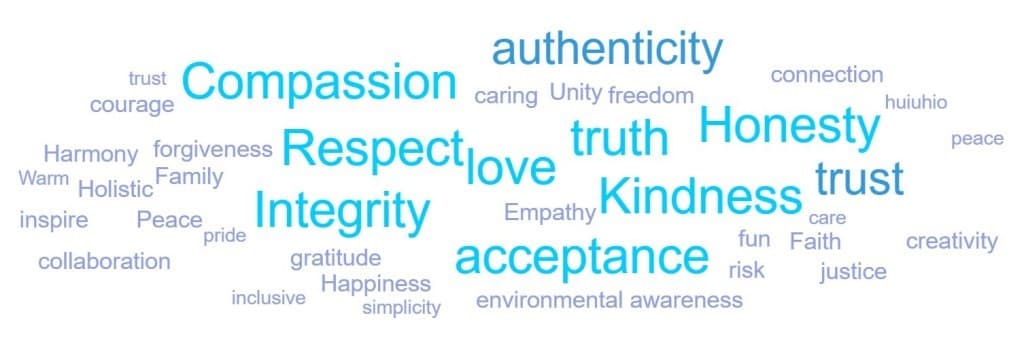
What are your values?
Values are the beliefs and principles you live your life by and these shape your choices, life direction and relationships. These can also be unconscious. Let’s explore a few simple examples of values and how they play out in life:
-
Cleanliness - You always make sure your home is clean and you experience discomfort when you visit a dirty home.
-
Equality - You believe that if your partner does the cooking, it’s only fair that you do the washing up after.
-
Harmony - Whenever you have an argument you never walk away unfinished, but always seek a solution and make up so the resentment is removed.
-
Inspiration - You only choose to do things when you feel inspired to do so, even if it means no cleaning gets done when you are inspired to write.
As you can see, values can differ, and some values will harmonize better with others. A key point to remember is that a compatibility of values is important and equally important is how we choose to prioritize them. The prioritization can also result in clashes even if you hold the same values as another. For example, if you value cleanliness and someone else you live with values inpsiration before cleanliness, it’s possible that conflict may arise about how clean the home is. This is why it is so important to understand your values and to be able to share them and their importance with potential colivers, whilst also being able to hear this from others.
In a Life Itself community call, Alan Williams, a values coach for organizations and individuals, presented his work around values. He shared a tool for individuals to extract, define and prioritize their values called 31Practices. It entails selecting 5 values from a list of 100 and journaling on them and how you practice them in your life.
While this may not lead you to completely understand your values immediately, it gets you into the practice of observing your values and how they show up in your life. Once you are aware of your values, you will begin to see how having aligned values and non-conflicting needs in a community is so important.
What are your needs?
While values are your core beliefs, needs are your absolute non-negotiables. Your needs can arise out of your values, as well as being shaped by childhood and past experiences, although we won’t address this here (that’s a whole other course!).
For example, if you value privacy you will most likely need a quiet space, a room with a door, or maybe even an entire building for yourself. On the other hand, if you don’t value privacy you’d probably be happy with a shared room. You can therefore use your values to become conscious of your needs.
You can probably guess why knowing your needs is so important for conscious coliving… Let's unpack the earlier example further; your need for a private room, may not actually be about a value of privacy but a need for a certain type of safety, for example. This brings us to the next important step whihc is you have to be able to truly understand your needs, and firstly figure out how to fulfill them yourself. Only then, can you understand how conscious coliving can support you, if at all. But remember, your needs are your responsibility, not your fellow colivers’ or the community’s, which is often why clashes can happen.
Take for example the different needs of a vegan and a meat eater. A vegan may state, “I can’t live with people who cook meat in the kitchen,” and view it as non-negotiable. If we were to dig a little deeper, the question would be whether this person’s choice is in fact a non-negiotable or simply that they would not be willing to share a kitchen with meat eaters. Being consciously aware of this value and how it embodies itself as a need enables you to avoid getting into any meaty situations in coliving environments 😉.
Here are some different needs that might cause contention:
-
One person needs the home to be warm; another needs to reduce electricity costs.
-
One person needs a quiet space to write; another person needs space to practice drumming and dancing.
-
One person needs a lot of flexibility in their calendar; another person needs routine and defined weekly calendar activities.
It is worth noting that the above examples are pretty superficial. Did you pick up on that? These are often our entry points, so there isn’t anything wrong with that. What makes this knowledge useful i.e. I need a warm house vs I need to save money on the electricity, is by digging a little deeper into it. What appears as a surface need can lead us to knowledge about our deeper values, priorities and even our insecurities. For example, perhaps the need to be warm is actually about being free to live how you want to live, whilst saving money on electricity is more about a scarcity mindset (than the actual money). The question then becomes how do you work with that and more importantly, can you?
It is also worth noting that you may have needs that can be fulfilled outside of your conscious coliving environment, for example intimacy with another person might not have to happen in the coliving space. So really dig deep to unpack these.
What are your desires?
🍨 “I would love it if the kitchen had an ice cream maker” - This is clearly not a need, but a desire. It's nice to have, but not necessary to live a nourishing life.
While values and needs are most important to consider when deciding who to live with, desires can be useful to know as well. Why? Because it's easy to confuse desires as needs.
The easiest way to figure out if something is a need or desire is to honestly reflect on whether living without something would cause you harm or not. If it won’t cause you harm, then it’s not truly a need. Here are some examples:
-
Swimming pool: nice to have, but it wouldn’t harm you to live without it unless you were an olympic athlete or used it for physio rehabilitation
-
Good stable internet: this is a need, because without this you cannot work, but a specific brand of desk and chair to do your work: a desire
-
Access to nature: this might depend on your values, but for many this is a need not just a desire
-
Availability of suitable schooling options for your children is a need, but two bathrooms, one for you, one for your child, is a desire
When it comes to conscious coliving, rather than listing down all your desires it is better to reflect on what you are willing to compromise. Coliving will always present challenges where you won’t always get what you want (which as humans, we hate), so knowing what you’re willing to be flexible with will help you decide what you can live without. For example, you might recognize that a living space with a lot of light and a good amount of space is imperative, but that you can compromise on how modern an apartment's design is, or its location.
There will be some internal struggle related to compromising on your desires, and this is where growth happens! And growth is the name of the game with conscious coliving🏏.
A final note
Values, needs and desires often change throughout life, but learning to be aware of them and how they show up in your life will always be a valuable skill. As you apply conscious coliving to your life, articulating your values, needs and desires will ensure you live in the most harmonious conscious coliving experience you can, both internally and externally.
Action time ✍️
Whip out the journal and reflect on your values, needs and desires.
-
Rank your top 5 values and how they show up in your life (use 31practices for reference).
-
List and prioritize your needs. Determine which are mandatory for your conscious coliving experience.
-
List your desires and which ones you are most likely to compromise on.
Dig a little deeper
- Once you have these listed and prioritized, use these to generate a list of questions to ask a potential coliver or coliving place.
Let’s use an example to help you get the most from this:
Honesty is one of my top values and I need to live in an environment where issues are raised immediately and not hidden. Do you value this as well?
I wanted to highlight the ‘problem’ with a statement as simple as this. Firstly, who do you know who would actively acknowledge they don’t value honesty? Secondly, have you really examined this value and how it is active in your life? Do you always speak up? Have you never told a white lie when you didn’t want to upset someone you loved? Equally, often the hardest person for us to be honest with is ourselves. Are you always honest with yourself? So, if you start with a value or statement like this, dig a little deeper. Is it open communication channels you value? An ability for a person to listen? Perhaps emotional maturity for you all to be able to have uncomfortable conversations? Or perhaps it’s more about an expectation you have that people receive what you say, which isn’t actually a value at all. You get the picture.
In this lesson, we’ve learned how to become more aware of our values, needs and desires and how to use this awareness to find the best conscious coliving environment.
In the next lesson, we will share how to prepare yourself to consciously colive.
Lauren & the Life Itself CoCo 🥥 team
If you have any feedback on the course, we’d love to hear it: [email protected]
P.S. This course is brought to you by Life Itself - https://lifeitself.org