Transforming Conflict in Community — Day 1
Day 1: Transforming Conflict in Community
Part of the free course Transforming Conflict in Community. Prefer it paced? Get it by email — one lesson a day.
Dear conscious human,
Today is the first day of Transforming Conflict in Community course 🥳.
After polling the Life Itself Community, and through our own experiences and its role within coliving environments, conflict came up as one of the top contenders to write a course on. We know it is needed, we also know it can have a bad reputation, which is why if you want to consciously colive you need to accept it and understand it as a part of life.
Conflict is not something that happens over there, it is live and in real-time, and brewing even as we speak 🍵.
Today we set the scene and give you background information to understand why it happens and how disruptive it can be to a community. As you read, we invite you to keep an open mind and get inquisitive to what gives you that little pull or even an ‘aha’ moment, it is usually where we feel the most discomfort that our greatest discoveries lie.
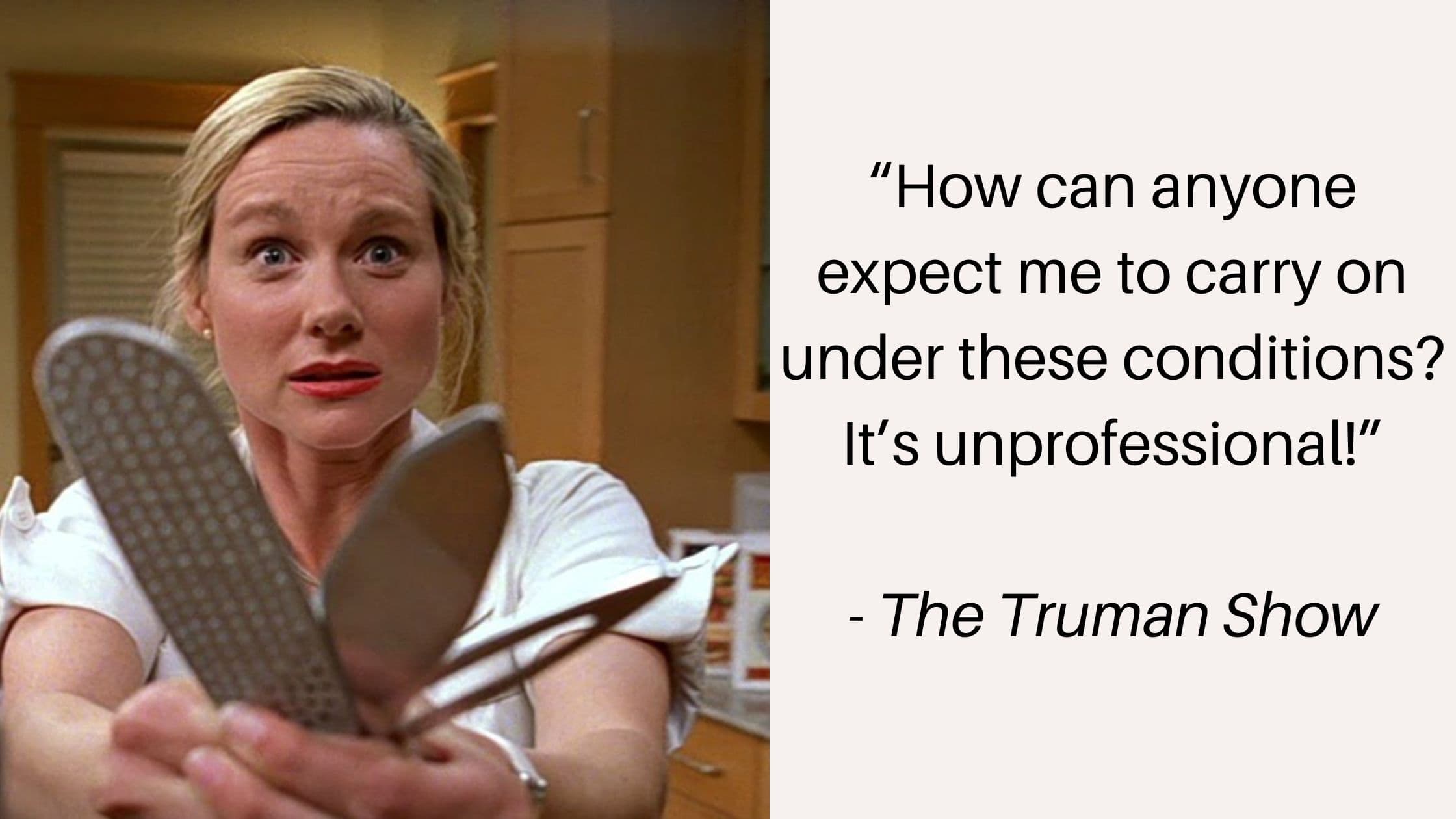
Life is not The Truman Show
The first thing to get clear on is that conflict happens, that’s life, there is no escaping it. Therefore, the first thing to do is to put down any hope of living in a conflict free reality because as we navigate life we don’t know what we’re going to get.
How enjoyable do you think life would be after the novelty of experiencing no conflict has worn off? A world without any conflict would be like living in The Truman Show, strange, disconnected, inauthentic and non-progressive. Equally, a reality full of conflict is not great either. Ideally we want to feel a sense of balance, an ability to move through life and encounter the unknown with grace, whilst acknowledging that if you’re living authentically, conflict will be inevitable at points.
Why does conflict happen?
First, let’s define what conflict is. **Conflict is the clashing of two or more opposing forces, resulting in a struggle, unease or a battle. **
In its most simplest explanation, conflict arises because of differences between people and how these differences are expressed, interpreted and managed.
There are numerous theories related to conflict, and we’ve outlined a few for you below.
Conflict theory, a Marxist perspective, considers society as an ongoing battleground due to the limitation of resources such as power and status, this limitation fosters competition and brings forth revolution. It interprets relationships as inherently unequal, resulting in war as a means of purification or unification.
Other sociological perspectives like feminist theory examine gender-based power imbalances, and critical theory explores the role of ideologies in fostering inequality amongst people. It is these inequalities that create conflict between individuals.
Psychology offers insights into the individual by examining behaviors, emotions, conditioning and motivations that can drive interpersonal conflicts, emphasizing factors such as perception, attitudes, and social influences in conflict escalation and resolution. Lastly, let’s not forget biology's role which can shed light on the physiological responses like stress and hormonal changes that can play a role in aggression and cooperation in social interactions.
\
Conflict especially happens in communities
Conflict happens around five main areas1, all of which are relevant to coliving situations:
- Information
- Values
- Interest
- Relationships
- Structure
Before we unpack these further, let’s dive into a short case-study to examine this in action.
A case study of conflict in community
The Osho Rajneesh Commune was established in Oregon in the 1980s. It was a community centered around the teachings of the spiritual leader Osho (Bhagwan Shree Rajneesh). It attracted thousands of followers seeking spiritual enlightenment, promising a lifestyle of freedom, meditation, and communal living.
However, the commune's downfall stemmed from the contrasting intentions of its leaders and the wider community. While Osho preached love, peace, and inclusivity, the leader of the commune, Ma Anand Sheela, and her inner circle seemed more focused on power and control, which eventually led to criminal activities of wiretapping, immigration fraud, and a bio-terror attack using salmonella.
A large part of the commune’s failure resulted from the discord between the leaders' choices and the community's foundational values. Osho's teachings focused on individual freedom, non-violence, and spiritual growth, values that attracted followers seeking a harmonious existence. However, Sheela's group prioritized control and dominance, frequently deviating from the commune's intended purpose. Their actions caused rifts within the community, eroded trust and ultimately led to legal repercussions, the demise of the commune and a tarnishing of Osho's reputation.
All 5 aspects of conflict featured in the demise as the misalignment between values, information, structural aspects, relationships and the focus of interest, all seemed to be contradictory to the original purpose of the community.
\
Conflict can blow up a community but it can also be a good thing
After the Osho Rajneesh Commune example you might be wondering, how can something that will blow up a community be a good thing? The difference lies in how it is approached.
When handled poorly, conflict can destroy, we see this on large and small scales in our lives; world wars, family feuds, shoppers arguing with shop assistants. I’m sure you all have your own examples that spring to mind for this and if not, we invite you to watch Phoebe, Rachel and co demonstrate this for us.
But, what might be slower to come to mind are the times when conflict has actually lent itself to change through creating space for transformation. And this is the beauty of conflict: that within its perceived destruction lies the seeds of growth.
You can be pushed, challenged, backed into a corner, trying to run, called up to fight, stressed, agitated, triggered and many other things but you will also have the opportunity to learn about yourself, learn about another, make a choice on how to view a situation, get out of your own way, and even potentially meet yourself for the first time. It’s really not all bad once you remove the fear or resistance to it.
Because conflict is inevitable and inherent in all human relationships, it is when it is handled unconsciously that it becomes destructive and it is this unconscious approach that blows up a community, not the existence of conflict itself.
\
Why controlling or overcoming conflict doesn't work
A key aspect to remember is that there are two sides of the coin and this can often be forgotten when we are in the midst of conflict, because we are often only focusing on our side, or the side we feel most aligned with.
Community living can feel like a boiling pot and conflict may actually happen, or feel like it happens more because of the very fact that you are in community. Whereas, if you only lived with your Mum for example, you could avoid her by not talking to her, or reducing the interactions you have. If you live on your own, you can certainly avoid (obvious) conflict, although you might end up more fearful when conflict shows its sexy little head. Our recommendation is that instead of avoiding it, you learn to embrace conflict as a natural part of life and to see it as an opportunity to grow and practice how to be your best self!
Further overlooked is that, within conscious community, support is available to navigate conflict. Support doesn’t always mean confirmation or agreement, although that can be a part of it, it also means challenging you in positive ways that support your growth, it means compassion, empathy, discipline, communication, accountability, mediation, and holding you up to your own inner greatness.
Therefore, we want you to finish today’s lesson understanding that conflict is a natural part of life that ultimately arises due to a (perceived) sense of inequality, and that conflict isn't going anywhere. By trying to avoid conflict you actually do an injustice to yourself and fellow community members.
So we end today’s lesson with these question for you to reflect on:
✍️ What are you missing or have you missed out on by avoiding living with people?
✍️ What ways do you see conflict as potentially being able to help you be your best self?
Do share any insights in the Conscious Coliving Whatsapp group, and we’ll see you tomorrow to debunk 8 myths and get you up to speed on conflict as it really is.
Lauren
Life Itself