Transforming Conflict in Community — Day 6
Day 6: Transforming Conflict in Community
Part of the free course Transforming Conflict in Community. Prefer it paced? Get it by email — one lesson a day.
Dear conscious human,
🥁 Drumroll please 🥁 I imagine this is why you signed up initially, the actual ‘how to’ of conflict resolution. Conflict is such a complex happening, and what we have covered is a mere sprinkling of it. We’ve provided you with the context and the wider grasping of how pieces fit together, and what you can do initially to prevent some conflicts arising.
Although conflict is inevitable, we hope you’ve realized not all of it needs to actually happen. But when it does, which can often leave you feeling bewildered, don't panic because today we’re going to share with you conflict resolution processes that can help.\
But I’m following all the right steps
We know, we hear you, but downfall number one usually comes in the form of knowing but not embodying. Following a defined process is useful, but only when it is coupled with the capacity to truly engage with it openly.
If you can’t listen, unjaded, limit your activation and act in good faith, then it will be hard to facilitate a conflict resolution process. For the rest of today’s lesson we aim to give you an overview of some processes that can be used within coliving situations. We would recommend doing more in-depth research of your own or signing up for our conflict resolution masterclass to experience it fully here.
The Conflict Resolution Model
The Thomas-Kilmann Conflict Model focuses on a two-dimensional approach of assertiveness and cooperativeness and the 5 conflict responses that sit within these dimensions. These are 5 responses that individuals can take in relation to conflict.\
🥊 Competing: A high assertive, low cooperation response, that posits the other individual against you, meaning there can only be one winner.
🤝 Collaborating: This is high assertiveness and high cooperation. It is available because of the ability for both parties to engage in mature discussions and understand the other's perspective, allowing them to work together to find a solution.\
⚖️ Compromising: This is the balanced approach, that allows all parties to get some of what they want, with the understanding they will also not get it all. This can take time to get to and can feel like a longer process when details need to be worked out.
👟 Avoiding: Low assertiveness and low cooperativeness. This one involves acting as if the conflict isn't there, often with a withholding of opinions and thoughts. It will only work for so long and will likely lead to bigger conflict in the future.
🕊️ Accommodating: Low in assertiveness but high in cooperation, this is the one that will likely feel more like a sacrifice, because you are choosing to give up your views to maintain harmony.
This diagram details each of these and who the win is for you, them, or both.
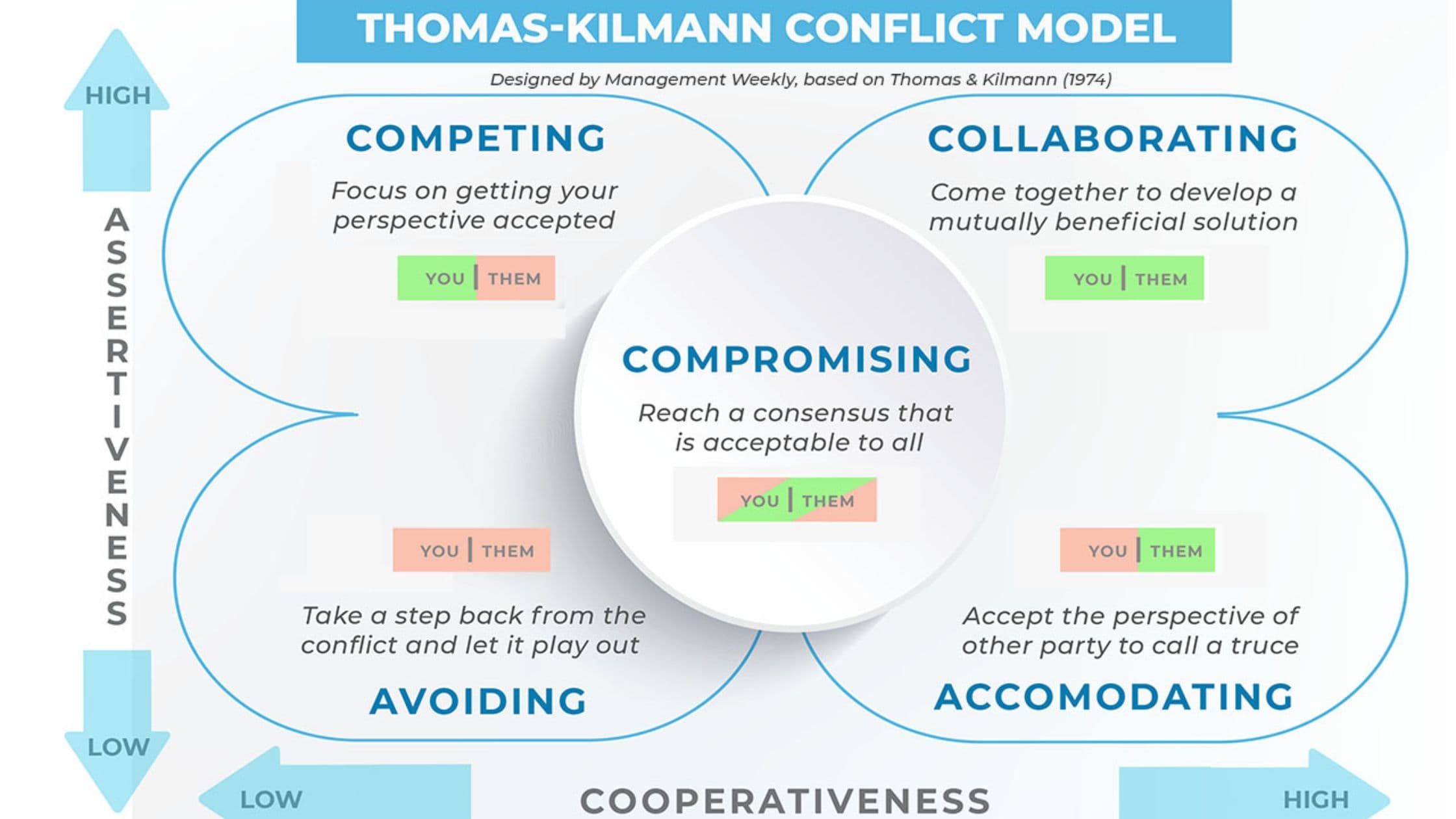
Image taken from https://managementweekly.org/thomas-kilmann-conflict-resolution-model/
✍️ **Do you recognise yourself in any of these? **
✍️ If you want to do a free test to understand your personal conflict style a bit more, I found one here.
Conflict Resolution Processes
So far we’ve gained an understanding of how we might show up in conflict through the Thomas Kilmann model, and also energetically through the control dramas we touched on in the previous lesson. Now let’s look at the common best conflict resolution processes we can work with. It’s worth noting there are lots of options and these are just a few curated examples that we recommend.
\
#1. Have a mediator
Working with an individual who can be and has the ability to remain impartial in the role of meditator, in a neutral space, can work wonders for conflict. Within this aspect, the ability to ensure there is space for balanced negotiation can be aided by having an object for holding when talking. Whilst also acknowledging the conflict and the validity of each person's emotions in the conflict helps to create a supportive, yet neutral environment.
Mediators Beyond Borders has a wealth of information related to larger scale mediation which might be of interest to you and Mediation Support UK for more general information.
\
#2 Perspective shifting
We can take a “physical” perspective which is about examining things closely, and paying attention to the specifics but many of us struggle to be able to take “view” perspective, which is more about understanding the bigger picture and what it represents as a whole, and it is this inability to shift from perspectives which is the source of so much conflict.
We touched on this in day 5 as an avoidance tactic but it is also important in the resolution process to transition from a "physical" perspective to a "view" perspective. This can be difficult for individuals and acknowledging this difficulty in shifting perspectives and supporting individuals to do so is an important part of resolving conflict.
\
#3 The 4 Rs process
The 4 Rs stands for - Recognition, Responsibility, Repair, and Reintegration. This process offers a structured framework for conflict resolution. In its simplest sense it involves recognizing the issue at hand, inviting in responsibility and holding parties accountable, seeking ways to repair the harm that has been caused, and reintegrating the lessons that have been learned to prevent similar conflicts in the future.
#4 Restorative Circling and building resilience through dialogues
Circling involves gathering individuals in a discussion circle to openly share their perspectives and experiences. This approach promotes active listening, empathy, and understanding among participants.
It can facilitate resolution through in-depth dialogues where members of the community can gain insight into other members positions, as well as foster robust communication channels to develop, and ultimately empowers individuals to navigate conflicts more effectively, thus fostering resilience and adaptability in handling future challenges.
Through restorative dialogues, individuals are invited to share their honest perspectives on the conflict, the impact it has had on them, and the potential harm it may have caused others. Together, all participants collaborate to identify solutions that address the harm caused and mend relationships.
For more on circling you can check out the Circling Institute.
#5 Family systems and how it plays out in communities
Family systems theory explores how individuals within a family unit function as an interconnected system, and how these dynamics extend into larger community structures because conflicts within communities often mirror patterns observed in family systems, which can lead to tension and discord. Through work done in a group setting, understanding that each member's behavior can impact the other, and that individual’s behaviors should be considered within the context of the wider family unit, we can often gain insight and develop a framework for targeted interventions that foster healthier communication, mutual respect, and ultimately, more sustainable resolutions.
Click here for a more therapeutic approach to family systems.
\
#6 Internal Family Systems
Although very similar sounding, Internal Family Systems is an entirely different model which focuses on the inner workings of an individual. Although not directly a conflict resolution process, it can be a good system to use individually to explore areas of inner conflict and suffering and to understand how your inner workings, or “parts” in IFS’ case, come together in a systematic way like members of a family, and that it is only underneath these parts that the true self sits.
\
#7 Process oriented approach to conflict: the solution is within the conflict itself
Embracing a process-oriented approach to conflict resolution is about working with the idea that a solution lies within the conflict itself. By delving into the core of the issue, exploring underlying concerns, and understanding the dynamics at play, a pathway towards resolution often emerges from within the conflict's complexities.
We ultimately recommend that any coliving situation has a process and therefore a language, that is used by all the members, and whilst processes are extremely helpful what is ultimately the most important is the willingness of everyone to be committed and fully involved in them.\
✍️ Which of the conflict resolution processes do you think would be the most useful?
The next lesson is the final one of the course, and if you're struggling to remember what we covered in day 1, don't panic we’ll tie everything together for you!
Lauren
Life Itself